
CONTROL
Rules decide. The language model renders.
A language model is good at understanding people. It should not be the last line of defence. In Relayn OS the model proposes, and rules your people approved decide what happens.
01 / The path
From a request to an action, in five steps.
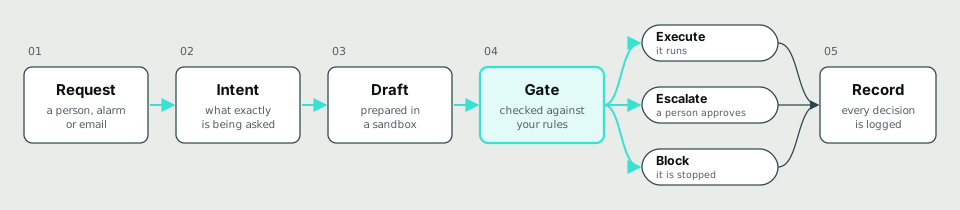
- Request. A person asks, an alarm fires, or an email arrives.
- Intent. Relayn works out exactly what is being asked and splits it into small jobs.
- Draft. An agent prepares the action in a sandbox. Nothing has touched your systems yet.
- Gate. The proposed action is checked against your rules. It runs, goes to a person for approval, or is blocked.
- Record. The decision, the rule behind it and the outcome are logged.
02 / Intent
It asks before it guesses.
Most AI agents work by trial and error. A valve that has been opened cannot be taken back. Relayn's intent layer is built to check first.
- It splits each request into small jobs, so a small model on your own server can handle each one reliably.
- It uses your history to work out what this pump or the usual channel means before it bothers anyone.
- When something is still missing, it asks.
On a public function-calling benchmark, this layer ran on a single consumer graphics card and scored within 2.5 points of a leading frontier model. See the numbers
03 / Rules
Your rules, in words your operators can read.
Rules are written in plain language, approved by named people and kept in versions, so you can see who changed what and when. Every proposed action is checked twice: once for what is being asked, and once for whether this action is allowed, for this person, now.
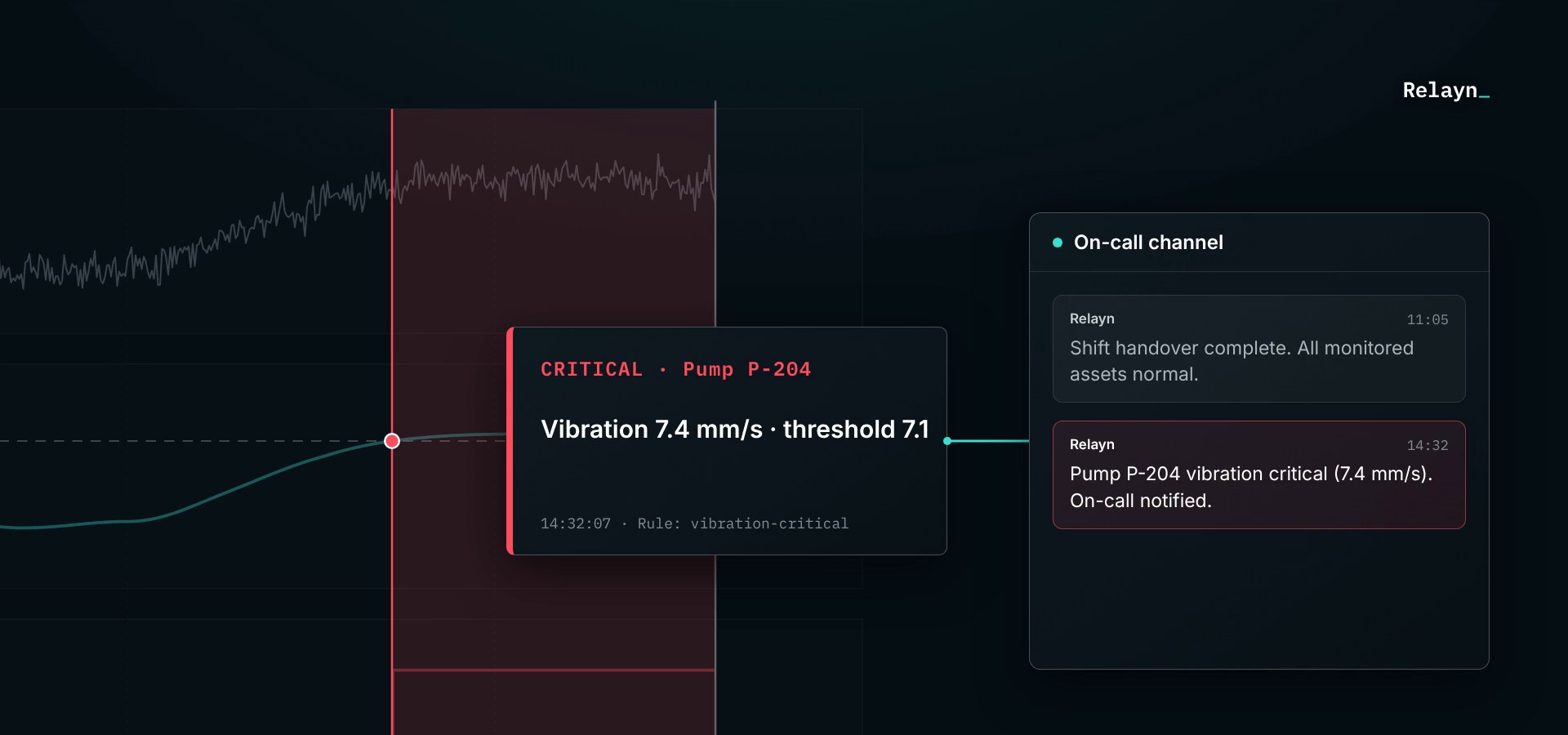
Rule: vibration-critical
When vibration on a pump stays above its limit for 12 seconds
Then notify the on-call engineer in the approved channel
Needs approval: opening a work order
Once the rules and conditions are set, the same situation leads to the same action. That part of Relayn is deterministic.
04 / Learning
More predictable, and cheaper, the longer it runs.
New and unusual cases go to a language model working inside your rules. When the same decision keeps coming back, Relayn learns a rule for it. Once that rule has proved at least as accurate, and a person has approved it, the rule takes over. Anything unfamiliar still goes to the model.
Model within rules
Handles what is new.
Learned rules
Take over what repeats in your organisation.
Locked rules
Routine cases, the same result every time.
In our own production use, 71% of requests no longer need a language-model call. How we measure